July 9, 2026 · Autoriax
Writing for Readers Who Don't Read: Adapting Content Structure for AI Search Snippets
Discover how to adapt content structure for AI search snippets. Learn atomic units and answer-first architecture for zero-click search success in 2026 now.

The traditional long-form blog post is facing an existential crisis. For decades, the goal of content marketing was to attract a visitor to a page, keep them there for several minutes, and guide them through a narrative funnel. However, by mid-2026, the fundamental way humans interact with information has undergone a seismic shift. We are no longer a society of readers; we have become a society of “information auditors” [11].
With the rise of Large Language Models (LLMs) and conversational search engines, the “click” is becoming a secondary metric. Data from the first half of 2026 reveals a staggering reality: 72% of search queries are now resolved entirely within AI-generated snippets, never requiring the user to visit the source website [3]. For brands and content creators, the challenge is clear: How do you remain relevant when your audience doesn’t actually read your website? At Autoriax, we believe the answer lies in transitioning from narrative-driven articles to “Answer-First Architecture”—a method of engineering content specifically for LLM extraction and snippet dominance.
Quick Facts: Writing for Readers Who Don’t Read: Adapting Content Structure for AI Search Snippets
- 72% of search queries are resolved via AI snippets without a click [3].
- Users now scan for facts rather than reading narratives linearly [4].
- Modular content units increase AI citation rates significantly [2].
The Rise of the Information Auditor
The shift in content consumption isn’t just about technology; it’s about psychology. A 2026 study on scanning patterns highlights that users no longer engage with digital text in a linear fashion. Instead, the traditional “F-pattern” has evolved into a fragmented “spot-check” approach where users glance at AI summaries to verify facts rather than consuming a full narrative [4]. This “Non-Reader” phenomenon is driven by the efficiency of AI Overviews. Why scroll through a 2,000-word guide on “How to Set Up a VPN” when a Google AI Overview or a Perplexity summary provides the exact five steps in bulleted form? [8].
As a result, users have shifted their role from passive readers to active information auditors—they use AI to synthesize data and only click through if they need deep-dive technical validation or transactional fulfillment [11]. This behavioral change demands a structural pivot in how content is created. Brands must stop writing for retention and start writing for extraction. The goal is no longer to keep the user on the page for ten minutes; it is to ensure your brand is the source cited in the ten-second answer.
From Linear Reading to Spot-Check Verification
Eye-tracking studies show users jump to bolded text and bullet points immediately. Narrative leads are skipped entirely by both users and AI. The modern user verifies information in seconds, not minutes. This requires content to be pre-digested for machine extraction to remain visible. If the AI cannot extract a clear answer quickly, it will move to a competitor who structures data more logically.
Key Takeaway: Users now act as information auditors, verifying facts via AI summaries rather than reading full narratives.
Why Narrative Prose Fails AI Extractors
LLMs prioritize speed of information retrieval; anecdotal intros are ignored. Traditional topic sentences followed by supporting details create ambiguity for snippet extraction. AI extractors need clear, decontextualized answers at the start of each block. If your article starts with a 300-word story about your morning coffee before getting to the point, the LLM will likely skip your content in favor of a competitor who uses an answer-first structure [12].
Behavioral science tactics suggest that while human subconsciousness is still influenced by brand authority, the AI bot—which acts as the gatekeeper—only cares about the speed of information retrieval [9]. Ambiguity in traditional paragraph structure, such as anaphora like “This is because…”, breaks snippet coherence. Each paragraph must be a complete answer without relying on previous text. This ensures that when the AI generates a snippet, it correctly cites your brand and interprets your data accurately [2].
The Death of the Anecdotal Hook
Three hundred-word stories before the point cause AI to skip the content. Answer-first structure wins every time in snippet selection. Writers must unlearn the habit of building up to a conclusion. In the age of AI search, the conclusion must be the first sentence. This aligns with how AI truncates and displays snippets in search results. If the answer is buried, the AI may skip to a competitor’s content.
Key Takeaway: Anecdotal introductions reduce snippet visibility; direct answers must precede all contextual details.
The Atomic Content Unit: Self-Contained Fact Blocks
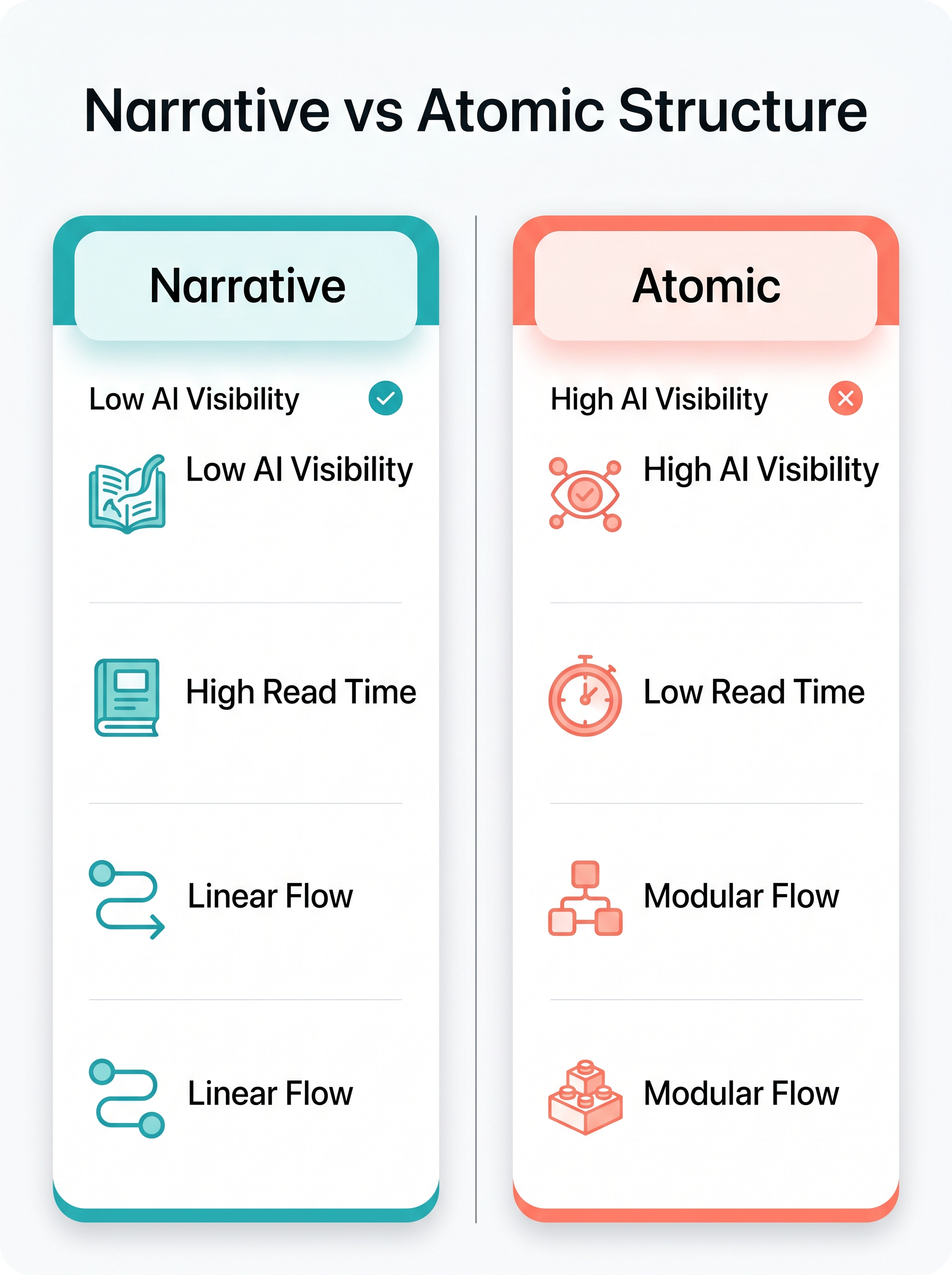
The future of content structure is modular. Agency leaders predict that to survive the decline of traditional page views, writers must adopt a “modular” approach, breaking articles into independent “Atomic Content Units” [1]. An Atomic Content Unit is a self-contained module that includes a direct question header, an answer-first paragraph, supporting data, and semantic metadata. This structure aligns with how LLMs index and retrieve information. Modular writing breaks articles into independent units that can stand alone.
Each unit includes a direct question header, such as “What are the tax implications of R&D credits?”. An answer-first paragraph provides a 40-60 word summary that provides the core answer immediately [8]. Supporting data includes a table or list that the AI can easily scrape [6]. Semantic metadata involves behind-the-scenes code that tells the AI exactly what this module represents [2]. This ensures that every section of your article can stand alone as an independent “Atomic Unit”.
Components of an Atomic Content Unit
Direct question headers map to user intent. Forty to sixty-word answer-first paragraphs provide core answers immediately. Supporting data in tables or lists allows for easy scraping by bots. Semantic metadata tells AI exactly what the module represents. Speakable and Micro-Summary schema tags act as TL;DR for bots. This modular design ensures content survives the transition to AI-first search.
Key Takeaway: Content must be broken into modular, self-contained Atomic Content Units for optimal AI extraction.
graph TD
    A[User Query] --> B[AI Search Engine]
    B --> C{Content Structure}
    C -->|Narrative| D[Low Extraction Probability]
    C -->|Atomic Unit| E[High Extraction Probability]
    E --> F[Snippet Dominance]
    F --> G[Brand Authority]
The Claim-Evidence-Context Micro-Unit
Optimal snippet structure is a three-part micro-unit: claim, evidence, context. This replaces the traditional topic sentence plus supporting details model. Claim is the answer, evidence is data or citation, context is scope or limitation. Perplexity and Google AI Overviews favor this structure for clarity. Comparison tables and numbered lists naturally fit this model.
Examples of effective micro-units include a claim like “R&D tax credits reduce taxable income by up to 20%.” Evidence follows: “According to IRS data, 85% of eligible startups claim this credit.” Context concludes: “This applies to companies with under $50M in revenue.” Data from H1 2026 confirms that certain structures “win” the most featured real estate. Comparison tables have the highest success rate for transactional queries. Numbered lists are preferred for “How-to” and process-oriented queries [6].
How Claim-Evidence-Context Maps to Snippet Selection
Perplexity and Google AI Overviews favor this structure for clarity. Comparison tables and numbered lists naturally fit this model. Writers should front-load the answer in the first 40 characters and avoid anaphora that breaks snippet coherence. This ensures that every section is optimized for zero-click extraction. Each H2 targets a distinct intent and provides a self-contained answer.
Key Takeaway: The Claim-Evidence-Context micro-unit is the preferred structure for AI snippet selection.
Front-Loading Answers and Avoiding Anaphora
The first 40 characters of a paragraph are critical for snippet extraction. Writers must place the core answer immediately, not after introductory phrases. This aligns with how AI truncates and displays snippets in search results. Google’s snippet algorithm often pulls the first sentence or phrase. If the answer is buried, the AI may skip to a competitor’s content.
Anaphora creates dependency on previous text. AI extractors treat each paragraph as an independent unit; anaphora breaks that independence. Rewrite to make each paragraph self-referential and complete. Common pitfalls include starting a paragraph with “This” or “These” without clear antecedent. Using “It” to refer to a concept from a previous sentence confuses the extractor. Replace “This is because…” with “The reason is…” and restate the subject. Ensure each paragraph can be read in isolation.
Techniques for Front-Loading
Start with the answer verbatim, then add context. Avoid filler words like “In order to understand…” or “First, let’s consider…”. The reason is that AI models favor content with clear provenance. Structure FAQ-worthy questions as H2/H3 headings with direct answers in the first sentence. Include a concise “Key Takeaway” or “In summary” paragraph per major section. Prefer factual, encyclopedic tone for introductory paragraphs.
Key Takeaway: Front-loading answers in the first 40 characters maximizes snippet extraction potential.
Technical Optimization: Schema and Semantic Markup
Search engine optimization in 2026 is less about “meta descriptions” and more about “AI-ready data.” Basic Schema like “Article” or “Product” is no longer sufficient. Modern Schema markup now includes “Speakable” and “Micro-Summary” tags that act as a “TL;DR” for the search bot [7]. This allows you to “pre-digest” your content, telling the AI, “If a user asks [X], use [Paragraph Y] as the primary source.” This ensures that when the AI generates a snippet, it correctly cites your brand and interprets your data accurately [2].
Semantic clarity is prioritized over keyword density. Perplexity AI recently shared insights into their indexing process, noting that they prioritize content structures that demonstrate clear hierarchy and logical flow [5]. An article that uses a table to compare three products is significantly more likely to be featured in an AI search snippet than an article that describes those same products in three long paragraphs [6]. Structured data like tables and lists significantly increase snippet appearance rates.
Speakable and Micro-Summary Schema
Speakable tags mark content for voice and AI overviews. Micro-Summary provides a TL;DR for bots, ensuring correct citation. Structured data that wins snippets includes comparison tables for transactional queries. Numbered lists are preferred for how-to queries. Definition boxes are ideal for “What is” queries. Is the content supported by 2026-standard Schema markup? This is a critical checklist item for AI-ready content.
Key Takeaway: Advanced Schema markup like Speakable tags is essential for guiding AI extraction accurately.
Behavioral Science: Converting the Auditor
If the AI snippet provides the answer, how does a brand actually convert a user? This is where the behavioral science of “fragmented content consumption” comes into play [10]. When an information auditor sees your brand cited as the source of a high-quality AI snippet, it builds “micro-authority.” According to Gartner’s 2026 Strategic Roadmap, brands are reallocating their budgets away from high-volume traffic generation and toward “Snippet Engineering” [10]. The goal is no longer 100,000 clicks; it is being the verified source for 100,000 AI answers.
Even if the user doesn’t read the whole page, they are influenced by hardwired subconscious buying processes [9]. These include source credibility, where being the cited link in a Google AI Overview acts as a modern-day “Seal of Approval.” Visual anchor points use bolded text within snippets to catch the “Information Auditor’s” eye during their scan [4]. The “Click-for-More” gap provides the “what” in the snippet but requires a click for the “how-to-implement” or the “calculator tool.”
Micro-Authority Through Snippet Ownership
Being the cited source in AI overviews acts as a modern seal of approval. Brands reallocate budgets from traffic generation to snippet engineering. Designing for the subconscious auditor requires using bolded text within snippets to guide scanning. Provide summary tables every 300 words for quick data verification. The decline of the traditional page view is not the death of content marketing; it is the evolution of it.
Key Takeaway: Snippet ownership builds micro-authority that influences user trust even without a click.
Conclusion
The decline of the traditional page view is not the death of content marketing; it is the evolution of it. As 72% of queries result in zero-click outcomes, the metric of success is shifting from “Time on Page” to “Snippet Dominance” and “Source Attribution Rate” [3, 10]. Brands that continue to write for the 2015 reader—who had the patience for long intros and narrative builds—will find their traffic evaporating. However, those who adapt to the Autoriax Framework of modular, AI-ready writing will find themselves as the primary voice in the conversational search era [2].
We are living through the “End of Reading” as we once knew it [11]. But for the savvy marketer, the rise of the “Non-Reader” is an opportunity. By engineering content that is fragmented, modular, and semantically clear, you don’t just hope for a click—you become the very intelligence that the AI search engine relies upon. To successfully adapt, marketing teams must pivot their editorial calendars. The transition from long-form blogs to Answer-First Architecture involves auditing for extraction, implementing snippet-first headers, and optimizing for the F-pattern evolution. Embrace these structural changes to define the future of search.
Sources
[1] Expert Predictions: The Future of Content Structure in an AI-First World - https://www.forbes.com/sites/forbesagencycouncil/2026/04/10/expert-predictions-the-future-of-content-structure/ [2] The Autoriax Framework: Engineering Content for LLM Extraction - https://autoriax.com/blog/engineering-content-for-llm-extraction [3] State of Search 2026: 72% of Queries Now Resolved via AI Snippets - https://blog.hubspot.com/marketing/state-of-search-2026-stats [4] Scanning Patterns in the Age of AI Search Summaries: 2025-2026 Study - https://www.nngroup.com/articles/scanning-patterns-ai-summaries/ [5] How We Index: What Content Structures Rank Best in Conversational Search - https://blog.perplexity.ai/posts/how-we-index-content-structures-2026 [6] Zero-Click Search Trends: Data from H1 2026 - https://www.semrush.com/blog/zero-click-search-trends-h1-2026/ [7] Schema Markup in 2026: Beyond Basic SEO to AI-Ready Data - https://www.searchenginejournal.com/schema-markup-2026-ai-ready-data/512304/ [8] Optimizing for Google AI Overviews: The 2026 Guide to Snippet Dominance - https://searchengineland.com/google-ai-overviews-optimization-strategies-2026-442105 [9] The Rise of the Non-Reader: Why Your Content Needs to be AI-Digestible - https://contentmarketinginstitute.com/articles/non-reader-content-strategy-2026 [10] 2026 Strategic Roadmap for AI-Driven Content Marketing - https://www.gartner.com/en/marketing/research/top-trends-in-ai-content-marketing-2026 [11] The End of Reading: How AI is Changing the Way We Consume Information - https://www.wired.com/story/the-end-of-reading-ai-information-consumption-2026/ [12] The Death of the Long-Form Blog? How Brands are Pivoting to Answer-First Architecture - https://www.marketingbrew.com/stories/2026/05/15/the-death-of-the-long-form-blog-answer-first-architecture
Try Autoriax free — no credit card required
Get your first article in minutes. See the research depth before you commit.
Get 3 free articles3 articles free • No credit card • Cancel anytime