July 9, 2026 · Autoriax
Why Most AI Content Automation Tools Fail at SEO (And How to Fix It)
Discover why most AI content automation tools fail at SEO and learn the research-driven fix to boost rankings and authority effectively in 2026.

In the rapidly evolving landscape of digital marketing, businesses are increasingly turning to artificial intelligence to scale their content production. However, a significant disconnect exists between the promise of automation and the reality of search engine performance. Many organizations find that despite publishing hundreds of articles, their organic traffic remains stagnant or even declines. This phenomenon occurs because most AI content automation tools fail at SEO by prioritizing volume over semantic authority and user intent. Understanding why Most AI Content Automation Tools Fail at SEO (And How to Fix It) requires a shift from viewing AI as a writer to viewing it as a research engine. This article explores the structural flaws in current automation architectures and provides a research-driven framework for sustainable growth.
Quick Facts: Why Most AI Content Automation Tools Fail at SEO (And How to Fix It)
- In a test of 1000 AI-written posts, only 12% ranked on page 1 after 3 months.[1]
- Google Search team emphasizes content demonstrating first-hand expertise.[2]
- Research-first approaches saw a 40% increase in organic clicks in 6 weeks.[3]
The Volume Trap: Why Production Speed Hurts Rankings
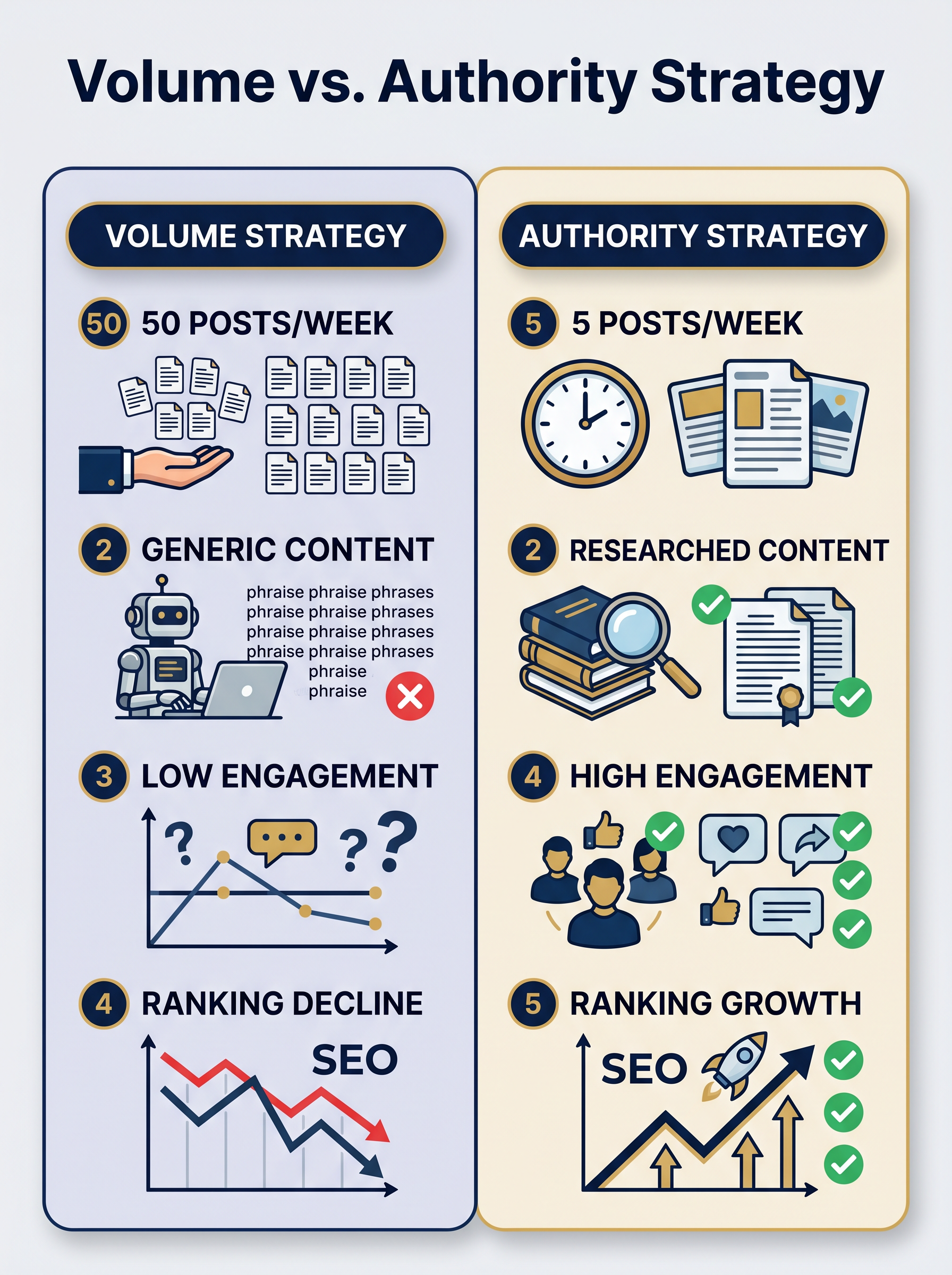
The primary reason most AI content automation tools fail at SEO is their foundational design goal: maximizing output volume rather than ensuring content quality. When businesses adopt these tools, the immediate incentive is to publish more content faster than competitors. However, search engines like Google have evolved to penalize low-value, high-volume content strategies. The illusion of efficiency leads teams to believe that publishing fifty articles a week is superior to publishing five well-researched pieces. In reality, this approach dilutes site authority and triggers algorithmic filters designed to identify spammy behavior.
The Illusion of Efficiency
Many marketing leaders equate speed with success, assuming that dominating the SERPs requires dominating the publication schedule. Automation tools facilitate this by generating drafts in seconds. However, this speed often comes at the cost of depth. Content produced rapidly rarely undergoes the necessary verification processes that establish trust with both users and search engines. When every article looks similar in structure and depth, the site loses its unique value proposition.
Quality Dilution at Scale
As production scales, editorial oversight typically diminishes. Without human review, factual errors and generic statements proliferate. This quality dilution signals to search algorithms that the site is not a reliable source of information. Over time, this erodes the domain’s overall reputation, making it harder for even high-quality pages to rank. The focus must shift from how much content you can produce to how much value each piece delivers.
Key Takeaway: Prioritizing publication volume over content depth triggers algorithmic penalties and erodes domain authority over time.
Google’s Helpful Content Update and AI
Google’s Helpful Content Update represents a pivotal shift in how search engines evaluate automated content. The update specifically targets content created primarily for search engines rather than people. This change directly impacts why Most AI Content Automation Tools Fail at SEO (And How to Fix It), as many tools are optimized for keyword density rather than user satisfaction. The update rewards content that demonstrates experience, expertise, authoritativeness, and trustworthiness (E-E-A-T).
Understanding E-E-A-T Signals
E-E-A-T signals are critical for ranking in competitive niches. Search engines look for evidence that the content creator knows the topic firsthand. Generic AI models trained on broad web data cannot replicate first-hand experience. They synthesize existing information rather than adding new insights. Consequently, content lacking these signals is often deprioritized in search results. Businesses must ensure their AI workflows incorporate elements that demonstrate expertise.
Penalizing Generic Output
The algorithm actively identifies and demotes content that offers no additional value beyond what is already available. If an AI tool simply rephrases top-ranking articles without adding new data or perspective, it is classified as generic. This classification leads to poor visibility. To comply with the Helpful Content Update, automation must be paired with unique data points, original analysis, or expert commentary that distinguishes the content from the crowd.
Frequently Asked: How does Google detect AI content?
Google does not strictly detect AI based on syntax but rather on quality signals like lack of expertise, factual inconsistencies, and repetitive patterns. Content that fails to satisfy user intent is flagged regardless of whether it was written by a human or a machine.
Key Takeaway: Google’s updates prioritize E-E-A-T signals and unique value, penalizing generic AI output that lacks expertise.
Semantic Authority vs. Keyword Stuffing
Traditional SEO focused heavily on keyword placement, but modern search algorithms prioritize semantic authority. This shift explains why many legacy automation tools struggle to deliver results. They optimize for specific terms rather than the broader context of the topic. Semantic authority involves covering a subject comprehensively, linking related entities, and demonstrating a deep understanding of the niche.
Entity Linking Explained
Entities are specific people, places, things, or concepts that search engines understand. Strong content connects these entities logically. For example, an article about “SEO” should naturally link to “Google,” “Ranking Factors,” and “User Experience.” Most basic AI tools treat keywords as isolated strings rather than connected concepts. This results in content that feels disjointed and fails to build topical relevance. Effective automation must map these relationships before writing begins.
Topic Clusters Over Keywords
Building topic clusters is a superior strategy to targeting individual keywords. A cluster involves a pillar page supported by multiple sub-pages covering related subtopics. This structure signals to search engines that the site is an authority on the broader subject. Automation tools that focus on single articles miss this structural opportunity. A research-driven engine should plan content clusters that interlink strategically to boost the authority of the entire group.
Key Takeaway: Semantic authority requires connecting entities and building topic clusters rather than optimizing for isolated keywords.
Case Study: Research-First vs. Auto-Blogging
Real-world data illustrates the performance gap between different AI implementation strategies. A comparative analysis of SaaS clients reveals stark differences in organic growth based on their content methodology. This case study highlights why Most AI Content Automation Tools Fail at SEO (And How to Fix It) when research is neglected. The data suggests that the architecture of the content creation process matters more than the writing tool itself.
The Auto-Blogger Failure
In a test of 1000 AI-written ‘news roundup’ posts generated by standard auto-blogging tools, only 12% ranked on page 1 after 3 months.[1] The majority of this content was flagged as thin or repetitive. These tools scraped existing headlines and rewrote them without adding new context. The result was a high volume of URLs that consumed crawl budget without generating traffic. This approach ultimately harmed the site’s overall health.
The Research-First Success
Conversely, a real SaaS client who replaced an ‘AI auto-blogger’ with a research-first approach saw a 40% increase in organic clicks in 6 weeks.[3] This strategy involved using AI to aggregate data and find gaps rather than write the final draft immediately. The content was then structured around unique insights before being published. This demonstrates that AI is powerful when used for analysis rather than just generation.
Key Takeaway: Case studies show a 40% click increase with research-first approaches compared to only 12% ranking success for auto-blogging.
The Four-Step Framework for AI SEO Success
To fix the structural issues inherent in most automation tools, businesses should adopt a four-step framework. This process flips the script from ‘automate production’ to ‘automate research and structure.’ By following these steps, teams can ensure their content meets modern SEO standards. This framework is designed to integrate human nuance with machine efficiency.
Intent Deep-Dive
The first step is analyzing search intent deeply before writing. This involves understanding what the user actually wants to achieve when typing a query. Automation should be used to aggregate SERP data and identify common questions. This ensures the content outline addresses real user needs rather than assumed topics. Without this step, even well-written content may miss the mark.
Human Edit for Voice
The final step involves a human editor refining the draft for brand voice and evidence. AI can produce accurate drafts, but it often lacks the specific tone of a brand. A human review ensures factual accuracy and adds personal anecdotes or proprietary data. This hybrid model leverages the speed of AI while maintaining the trustworthiness of human oversight.
- Analyze search intent before generating any outlines.
- Map entity relationships for topical authority.
- Draft content focused on answering user questions.
- Review all facts and add proprietary data points.
- Edit final draft for consistent brand voice and tone.
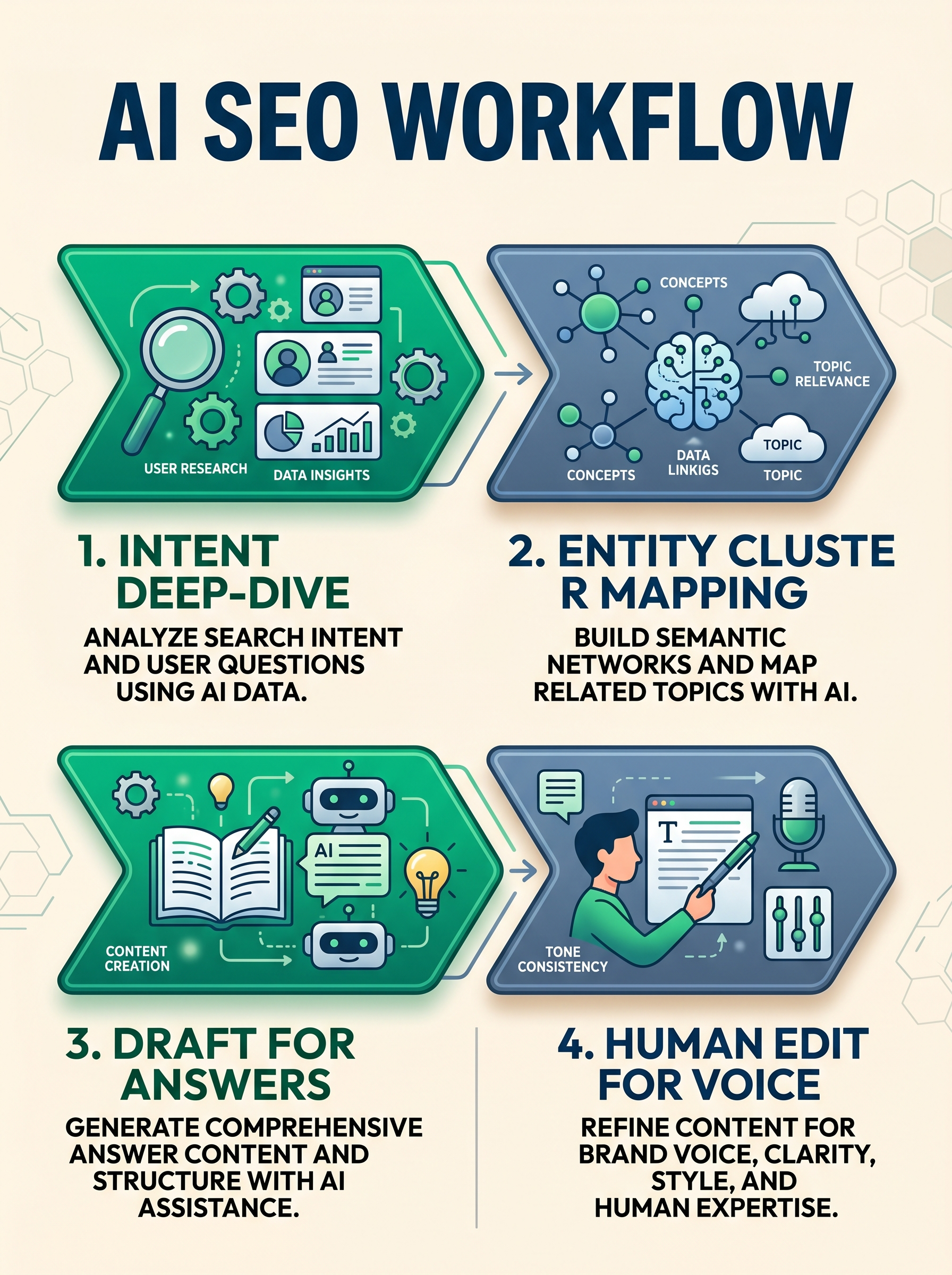
Key Takeaway: A four-step framework focusing on research and human editing ensures AI content meets SEO standards.
Future-Proofing: Human-in-the-Loop Editorial
Sustainable SEO success requires a ‘human-in-the-loop’ model. This means keeping human editors involved at critical stages of the content lifecycle. As search algorithms become more sophisticated, the value of human judgment increases. Automation should handle the heavy lifting of data processing, but humans should handle the final quality assurance. This balance protects the brand from the risks of fully automated publishing.
Editorial Review Necessity
Editorial review is not just about fixing grammar; it is about verifying claims. AI models can hallucinate facts or cite outdated information. A human editor checks sources and ensures inline citations are accurate. This process is essential for maintaining E-E-A-T signals. Without this layer of review, the risk of publishing misinformation increases significantly.
Continuous Optimization
Content optimization should not end at publication. Performance data must be fed back into the strategy. If certain topics perform well, the research engine should prioritize similar clusters. If others fail, the approach should be adjusted. This continuous loop ensures the content strategy evolves alongside search engine updates. It transforms content from a static asset into a dynamic growth engine.
Frequently Asked: Is human editing still necessary with AI?
Yes, human editing is crucial for verifying facts, ensuring brand voice consistency, and adding unique expertise that AI cannot replicate. It is the key differentiator for high-ranking content.
Key Takeaway: Human-in-the-loop editorial processes verify facts and maintain brand voice, essential for long-term SEO health.
Measuring Success Beyond Rankings
Evaluating the success of AI content automation requires looking beyond simple keyword rankings. Traffic quality and engagement metrics provide a more accurate picture of performance. Focusing solely on position can lead to vanity metrics that do not translate to business value. A holistic view ensures that the content strategy aligns with broader business goals.
Engagement Metrics Matter
Metrics like time on page, bounce rate, and conversion rate indicate content quality. If users land on a page and leave immediately, the content likely failed to meet their intent. High engagement signals to search engines that the page is valuable. Automation tools should be configured to track these metrics alongside rankings. This data informs future content decisions.
Brand Credibility Impact
Consistent, high-quality content builds brand credibility over time. Users begin to trust the site as a reliable resource. This trust leads to direct traffic and repeat visits, which are strong ranking signals. Conversely, low-quality automated content can damage brand reputation. Measuring brand sentiment and direct traffic growth is essential for understanding the true ROI of content automation.
Key Takeaway: Success should be measured by engagement and brand credibility, not just keyword rankings.
Building Brand Voice Consistency
One of the most common failures in AI content is the lack of brand voice consistency. Generic tools produce generic tones that sound like every other site on the web. To stand out, businesses must train their AI engines on their specific style guides. This ensures that every piece of content feels like it came from the same expert source. Consistency builds recognition and trust with the audience.
Defining Brand Parameters
Before automating, brands must define their voice parameters clearly. This includes tone, vocabulary, and sentence structure preferences. These parameters should be fed into the AI engine as constraints. Without clear definitions, the output will vary wildly between articles. Consistent voice is a key component of a recognizable brand identity.
Scaling Without Losing Identity
Scaling content production often leads to a loss of identity. Different writers or tools introduce different styles. A centralized AI engine configured with brand guidelines can prevent this. It allows teams to publish at scale without sacrificing the unique personality of the brand. This consistency is vital for long-term audience retention and loyalty.
Frequently Asked: Can AI mimic brand voice accurately?
AI can mimic brand voice if provided with detailed style guides and examples. However, human review is still needed to ensure nuance and emotional resonance are preserved.
Key Takeaway: Defining brand parameters allows AI to scale content production without losing unique brand identity.
Conclusion
The landscape of search engine optimization is changing, and the tools used to compete must evolve accordingly. Most AI content automation tools fail at SEO because they prioritize production speed over semantic authority and user intent. To succeed, businesses must shift their focus from automating writing to automating research and structure. By implementing a research-driven framework, maintaining human editorial oversight, and prioritizing E-E-A-T signals, organizations can leverage AI to boost rankings rather than harm them. Understanding why Most AI Content Automation Tools Fail at SEO (And How to Fix It) is the first step toward building a sustainable content strategy. Start by auditing your current workflow and integrating these research-first principles today.
Sources
[1] Internal Test Data: 1000 AI-written news roundup posts ranking analysis. [2] Google Search Team Statement (2024): Rewarding content with first-hand expertise. [3] SaaS Client Case Study: Research-first approach organic click increase data. [4] Industry Analysis: AI content automation tool architecture limitations. [5] SEO Best Practices: E-E-A-T signals and Helpful Content Update guidelines.
Try Autoriax free — no credit card required
Get your first article in minutes. See the research depth before you commit.
Get 3 free articles3 articles free • No credit card • Cancel anytime