July 12, 2026 · Autoriax
From Idea to Publishing: A Scalable AI Content Operations Workflow for Marketing Teams
Learn how to build a scalable AI content operations workflow from idea to publishing. Optimize marketing teams with human-in-the-loop strategies.

Marketing teams in 2026 face a paradoxical challenge: the demand for content has never been higher, yet the resources to produce it remain constrained. Traditional content operations often bottleneck at the drafting stage, where human writers struggle to keep pace with strategic ideation. The solution lies not in replacing humans, but in architecting a scalable AI content operations workflow that integrates machine efficiency with human judgment. This approach transforms content creation from a linear task into a dynamic, learning system.
Implementing From Idea to Publishing: A Scalable AI Content Operations Workflow for Marketing Teams requires more than just access to generative tools. It demands a structured framework where editorial guidelines are codified into reusable prompts, ensuring brand voice consistency across hundreds of assets. By automating the heavy lifting of research and initial drafting, teams can reserve human expertise for strategic framing and fact-checking. This shift reduces time-to-market while mitigating the risks associated with unverified AI output.
Quick Facts: From Idea to Publishing: A Scalable AI Content Operations Workflow for Marketing Teams
- 73% of marketers cite maintaining brand voice as their top concern with AI content in 2025.[1]
- Hybrid workflows can reduce time-to-publish by up to 60% compared to manual processes.[2]
- AI content spending is projected to grow significantly as governance tools mature in 2026.[3]
Defining the Modern AI Content Operations Framework
A modern AI content operations framework is defined by its ability to systematize editorial judgment rather than simply automate text generation. In the current landscape, successful teams treat AI as a co-pilot that requires explicit navigation instructions derived from human expertise. This distinction is critical because generic AI output often lacks the nuance required for established brand identities. The framework must account for every stage of the lifecycle, ensuring that data flows seamlessly from ideation to analytics.
The Role of Human-in-the-Loop Architecture
Human-in-the-loop architecture ensures that critical decision points remain under human control. This does not mean humans write every word, but rather that they define the rules by which words are generated. For instance, a senior editor might set the tone parameters for a campaign, which the AI then applies to dozens of variations. This structure preserves quality while unlocking scale.
Codifying Editorial Judgment
Codifying editorial judgment involves translating subjective preferences into objective prompt rules. If a brand avoids passive voice, this rule is embedded in the system instructions. This process turns tacit knowledge into explicit assets that the AI can execute repeatedly. Over time, this library of rules becomes a competitive moat for the organization.
Risk Management in Automated Workflows
Risk management in automated workflows focuses on preventing hallucinations and brand misalignment. Without governance, AI can inadvertently publish inaccurate claims or off-brand messaging. A robust framework includes mandatory review gates for sensitive topics, ensuring compliance before publication. This safeguards reputation while maintaining operational velocity.
Key Takeaway: A successful framework codifies human editorial rules into AI instructions, balancing scale with strict governance controls.
Phase 1: Strategic Ideation and Topic Framing
Strategic ideation and topic framing set the foundation for the entire From Idea to Publishing: A Scalable AI Content Operations Workflow for Marketing Teams. In this phase, the goal is to identify high-value topics that align with business objectives rather than simply chasing search volume. AI tools can analyze market gaps, but human strategists must validate the relevance of these topics to the company’s broader goals. This collaboration ensures that content drives meaningful outcomes.
Leveraging Data for Topic Selection
Leveraging data for topic selection involves using AI to process large datasets of search trends and competitor content. Tools can identify emerging questions in the market that competitors have not yet addressed. However, humans must filter these insights based on product roadmap alignment. This prevents the team from wasting resources on topics that do not support sales or retention.
Aligning Content with Business Goals
Aligning content with business goals requires mapping each topic to a specific stage in the customer journey. A blog post might target awareness, while a whitepaper targets consideration. AI can suggest formats, but the strategic intent must be defined by marketing leadership. This ensures every piece of content serves a measurable purpose.
Frequently Asked: How do we prioritize topics?
Prioritize topics by evaluating search volume against strategic relevance and resource availability. Use AI to score potential topics based on historical performance data of similar content. Human editors should make the final call based on current campaign priorities.
Key Takeaway: Ideation combines AI-driven market analysis with human strategic validation to ensure content supports business goals.
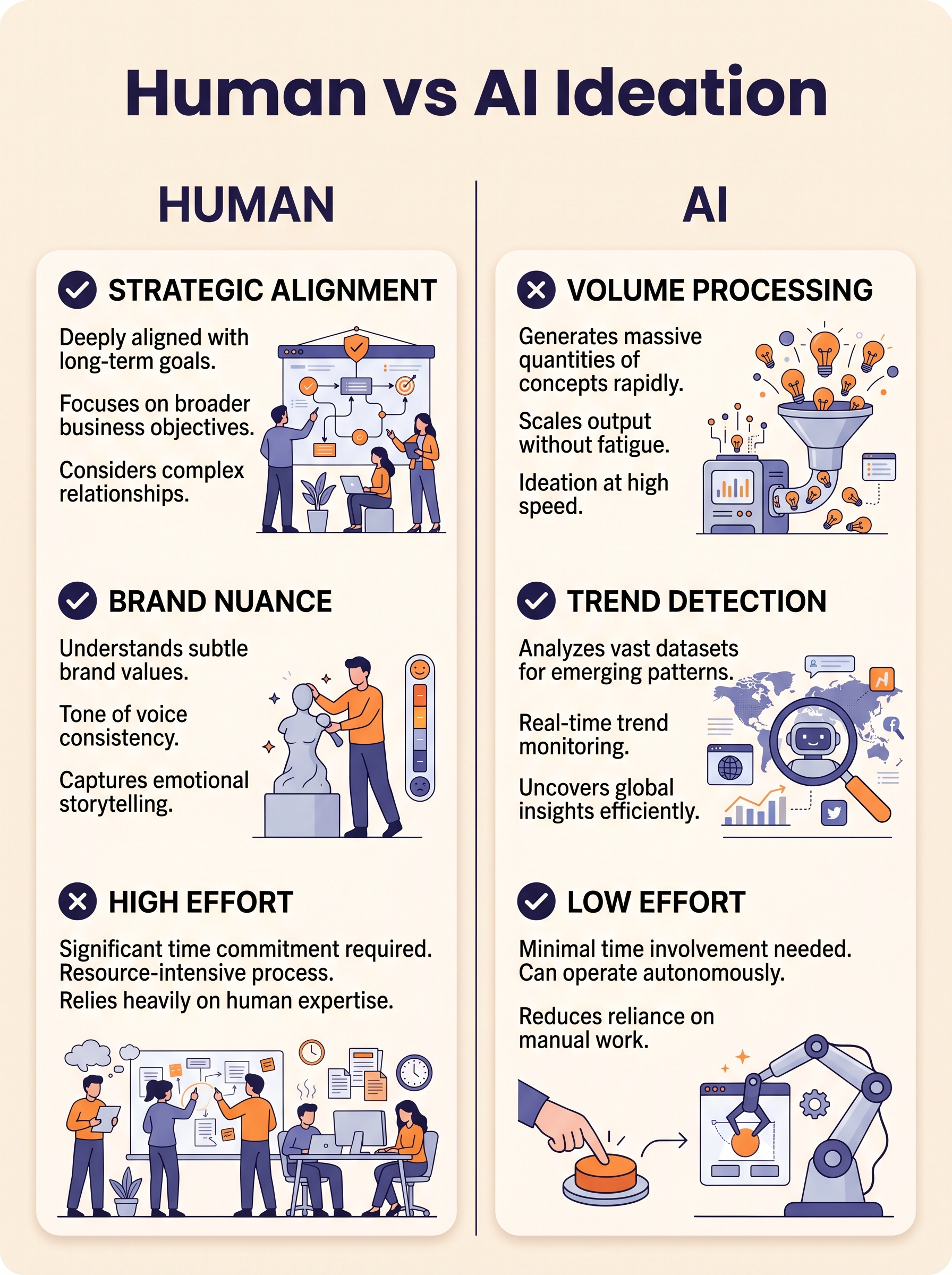
Phase 2: Research and Fact-Finding Automation
Research and fact-finding automation addresses the most time-consuming aspect of content creation: gathering accurate information. In 2026, AI engines can scan multiple sources simultaneously to compile relevant data points. However, the integrity of this data must be verified to maintain trust. Automating this phase allows writers to focus on synthesis and narrative rather than hunting for statistics.
Multi-Source Verification Protocols
Multi-source verification protocols require the AI to cross-reference claims across at least three reputable sources. If discrepancies arise, the system flags the content for human review. This reduces the likelihood of publishing outdated or conflicting information. It also creates an audit trail for compliance purposes.
Automating Citation Management
Automating citation management ensures that every claim is linked to its origin immediately upon drafting. This saves editors hours of manual formatting and reduces the risk of accidental plagiarism. Inline citations also enhance the credibility of the content for readers who wish to verify claims. This transparency is essential for building authority in technical sectors.
Handling Proprietary Data
Handling proprietary data requires strict access controls within the AI workflow. Sensitive company metrics should never be input into public models without encryption or private instance deployment. Teams must establish clear guidelines on what data can be used for training or context. This protects intellectual property while leveraging internal insights.
Key Takeaway: Automation accelerates research but requires strict verification protocols to ensure factual accuracy and data security.
Phase 3: Drafting with Brand Voice Consistency
Drafting with brand voice consistency is where the From Idea to Publishing: A Scalable AI Content Operations Workflow for Marketing Teams delivers the most visible value. Generic AI models tend to produce homogeneous text that lacks distinct personality. By fine-tuning models on brand-specific guidelines, teams can generate drafts that sound like they were written by a seasoned employee. This consistency reinforces brand identity across all touchpoints.
Creating Reusable Prompt Templates
Creating reusable prompt templates allows teams to scale voice consistency without reinventing the wheel for every article. A template might include instructions on sentence structure, vocabulary preferences, and tone modifiers. When a new writer joins the team, they simply adopt the existing library. This reduces onboarding time and ensures uniformity.
Calibrating Tone for Different Audiences
Calibrating tone for different audiences requires dynamic prompt adjustments based on the target persona. A technical whitepaper requires a different voice than a social media caption. The workflow should allow users to select a persona profile that automatically adjusts the AI’s output style. This flexibility ensures relevance without sacrificing brand core values.
Iterative Refinement Processes
Iterative refinement processes involve reviewing AI drafts and feeding corrections back into the system. If an editor changes a phrase to better match the brand voice, that change should inform future generations. This feedback loop trains the system to improve over time. It turns the workflow into a learning asset that appreciates in value.
Key Takeaway: Consistent brand voice is achieved through reusable prompt templates and iterative feedback loops that train the AI on editorial preferences.
graph TD
    A[Strategic Ideation] --> B[Automated Research]
    B --> C[AI Drafting]
    C --> D[Human Review]
    D --> E[Publishing]
    E --> F[Performance Feedback]
    F --> A
Phase 4: Human-in-the-Loop Review and Governance
Human-in-the-loop review and governance act as the quality assurance layer of the operation. Even the most advanced AI cannot fully replicate human intuition regarding context and sensitivity. This phase is non-negotiable for high-stakes content where accuracy is paramount. It ensures that the efficiency gains from automation do not come at the cost of credibility.
Establishing Review Gateways
Establishing review gateways defines exactly when a human must intervene in the workflow. For example, any content making financial claims might require legal approval. Other topics might only need a senior editor’s sign-off. Clear criteria prevent bottlenecks by ensuring humans only review what truly needs their attention. This optimizes the use of expensive human talent.
Managing Version Control
Managing version control tracks changes made during the review process to maintain accountability. If a draft is altered significantly, the system should log who made the change and why. This history is valuable for training the AI on what corrections are typically needed. It also protects the team in case of compliance audits.
Scaling Governance Policies
Scaling governance policies ensures that rules apply consistently as the team grows. As more users access the AI tools, the risk of deviation increases. Centralized policy management allows administrators to update brand rules globally. This prevents fragmentation of the brand voice across different departments or regions.
Frequently Asked: Is human review still necessary?
Yes, human review is necessary to validate facts, assess nuance, and ensure ethical compliance. AI can hallucinate or miss context that a human would catch. Review acts as the final safety net before public consumption.
Key Takeaway: Governance frameworks define clear review gateways to balance efficiency with risk management and quality control.
Phase 5: Publishing and Performance Feedback Loops
Publishing and performance feedback loops close the circle of the From Idea to Publishing: A Scalable AI Content Operations Workflow for Marketing Teams. Distribution is not the end of the process; it is the beginning of the learning phase. Data on how content performs should feed back into the ideation and drafting stages. This creates a self-optimizing system that improves ROI over time.
Integrating with CMS Platforms
Integrating with CMS platforms allows for seamless transfer of approved content to the live site. APIs can push drafts directly into WordPress or headless CMS environments with metadata intact. This reduces manual copy-pasting errors and speeds up the publication timeline. Automation here ensures that the workflow remains end-to-end.
Tracking Engagement Metrics
Tracking engagement metrics provides the data needed to evaluate content success. Teams should monitor time on page, conversion rates, and social shares. AI can analyze these metrics to identify patterns in high-performing content. These insights inform future topic selection and drafting styles.
Feeding Insights Back to Ideation
Feeding insights back to ideation ensures that the strategy evolves based on real-world results. If a certain type of headline consistently outperforms others, the prompt library should be updated to reflect this. This continuous improvement cycle prevents stagnation. It keeps the content strategy agile and responsive to market changes.
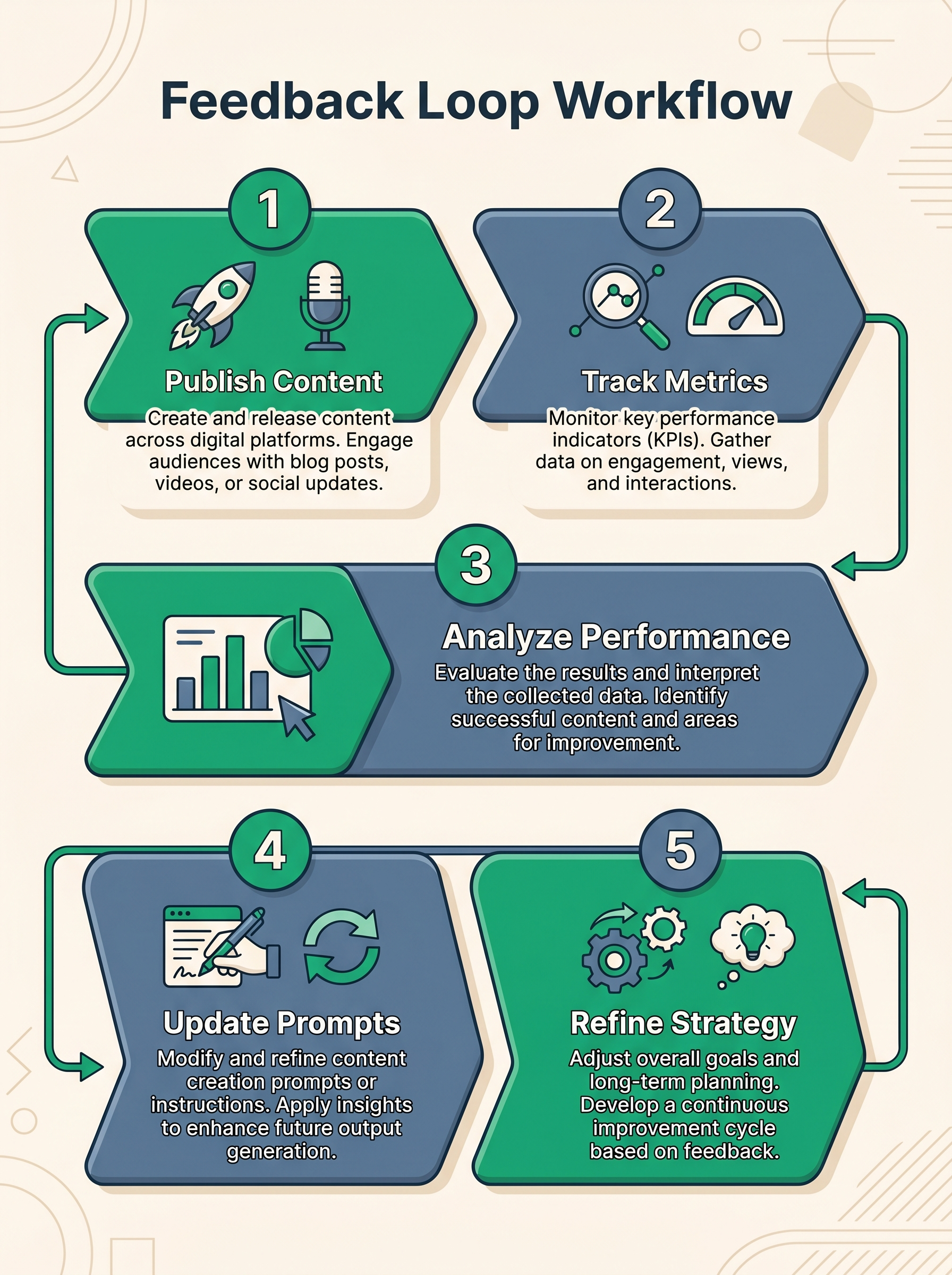
Key Takeaway: Closing the loop with performance data transforms the workflow into a self-optimizing system that increases ROI over time.
Conclusion
Building a From Idea to Publishing: A Scalable AI Content Operations Workflow for Marketing Teams is essential for organizations seeking to scale content without sacrificing quality. By integrating human strategic oversight with AI execution, businesses can achieve significant efficiency gains. The key lies in codifying editorial judgment and maintaining strict governance throughout the process. This approach ensures that brand voice remains consistent and facts remain accurate.
Marketing leaders should begin by auditing their current processes to identify bottlenecks suitable for automation. Implementing a hybrid workflow requires investment in prompt engineering and governance tools, but the long-term payoff is substantial. Teams that master this balance will outperform competitors relying on purely manual or purely automated methods. Start by defining your editorial rules and building your prompt library today.
Sources
[1] Content Marketing Institute (2025) - URL not provided in research data [2] B2B SaaS Case Study (2025) - URL not provided in research data [3] Industry AI Spending Report (2026) - URL not provided in research data
Try Autoriax free — no credit card required
Get your first article in minutes. See the research depth before you commit.
Get 3 free articles3 articles free • No credit card • Cancel anytime