July 12, 2026 · Autoriax
Automating Content Gap Analysis for Competitive Niches Using AI Research Tools
Learn how to automate content gap analysis for competitive niches using AI research tools. Discover workflows, tools, and strategies for 2026 SEO.

In 2026, the landscape of search engine optimization has shifted from a keyword-centric model to a complex ecosystem dominated by AI Search and Answer Engine Optimization (AEO). The traditional method of manual content audits—relying on painstaking spreadsheet tracking and human intuition—is now considered obsolete for competitive niches [3]. Today, the difference between market leaders and those stuck on page two is the ability to leverage automated content gap analysis to identify not just what keywords are missing, but what information is lacking to earn citations from Large Language Models (LLMs). With AI Overviews reportedly reducing clicks on the number one organic result by as much as 58%, the stakes for content coverage have never been higher [5]. To thrive on domains like autoriax.com, brands must transition toward “Agentic SEO,” where AI research tools autonomously monitor, analyze, and prioritize content opportunities in real-time [9].
Quick Facts: Automating Content Gap Analysis for Competitive Niches Using AI Research Tools
- AI Overviews reduce clicks on the #1 organic result by up to 58% [5].
- Firms using automated gap analysis report a 40% increase in content ROI [11].
- Manual SEO audits can take 5 hours, while automation reduces this to under 5 minutes [Product Truth].
The Evolution of Content Gap Analysis: From Keywords to Information Gain
Historically, content gap analysis was a reactive process: comparing your keywords against a competitor’s and finding the “missing” terms. In the current era, a “gap” is defined more broadly across four dimensions, fundamentally changing how strategists approach automating content gap analysis for competitive niches using AI research tools [19].
Beyond Simple Keyword Missing Lists
The first dimension involves Topic Gaps, where entire subject areas lack depth on your site [19]. The second is Intent Gaps, where content exists but fails to match the user’s goal, such as providing a guide when the user wants a comparison [21]. The third dimension addresses Quality or Originality Gaps, where content merely rehashes existing consensus without providing “Information Gain”—a metric now prioritized by AI models [5]. Finally, the most critical gap in 2026 is the AI Citation Gap. This occurs when ChatGPT, Perplexity, or Google AI Overviews cite a competitor instead of you because your content lacks specific data or structural clarity [5].
The Cost of Manual Methods
Firms that have integrated automated gap analysis tools report a 40% increase in content ROI compared to those stuck in manual research cycles [11]. Manual processes cannot keep pace with real-time SERP changes and AI Overviews, making continuous monitoring essential rather than quarterly audits [3]. Competitive niches require this agility to maintain “Information Gain,” as AI models prefer the most complete and fresh source available [5].
Key Takeaway: Modern content gaps extend beyond missing keywords to include intent, originality, and AI citation opportunities, requiring automated tools to track effectively.
Technological Foundation: AI Research Agents and Real-Time SERP Monitoring
The “Death of the Manual Content Audit” is driven by the rise of AI research agents that can simulate user personas to identify exactly what information is missing from the top-ranking results [3]. These tools move beyond database lookups to understand semantic relationships and query patterns across multiple languages [10].
Retrieval-Augmented Generation (RAG) in Gap Analysis
The technical backbone of modern tools often involves Retrieval-Augmented Generation (RAG). This technology allows AI agents to analyze thousands of competitor pages simultaneously to find structural and topical gaps automatically [4]. This shift toward “Agentic SEO” means tools now autonomously identify and prioritize content gaps without human intervention [9]. RAG enables AI to find structural and topical gaps across large datasets, powering tools that simulate user queries to identify missing information [14].
Real-Time SERP Volatility
In competitive niches, the SERP is no longer static. Real-time SERP monitoring has become the new standard, allowing tools to suggest immediate content updates as competitor movements or search intent shifts occur [1]. This agility is essential for maintaining visibility. For instance, platforms like Autoriax automate SEO audits to reduce them from approximately five hours to under five minutes, ensuring that teams can react to these shifts instantly [Product Truth]. This speed is critical when SERP changes in competitive niches require immediate content updates [1].
Key Takeaway: AI research agents utilizing RAG and real-time monitoring allow brands to react to SERP volatility faster than manual audits ever could.
Top AI Research Tools for Content Gap Automation in 2026
Choosing the right tool stack is vital for dominating a niche. While traditional platforms like Ahrefs and Semrush remain industry standards for keyword-level intelligence, a new class of AI-first tools has emerged to handle semantic and citation gaps [8].
Ranklytics and Automation Powerhouses
Ranklytics is designed to eliminate spreadsheets entirely. It automatically finds your top organic competitors, scans thousands of their keywords, and detects missing topics in seconds [2]. Its “Gap Prioritization Engine” scores opportunities based on traffic potential, competition difficulty, and monetization value, offering a structured content strategy rather than a messy list [2].
Citation and Visibility Specialists
Slate is built specifically for the AI search era, focusing on citation optimization to help teams understand why their content isn’t appearing in AI-generated answers [5]. Otterly.ai monitors brand visibility across AI search results, quantifying the “AI citation gap” by showing which competitors are being cited for your target queries across ChatGPT and Perplexity [5].
Comparison of Leading Tools
To visualize the landscape, here is how top tools compare in functionality:
| Tool | Primary Focus | Key Feature |
|---|---|---|
| Ranklytics | Keyword & Topic Gaps | Gap Prioritization Engine [2] |
| Slate | AI Citation Optimization | Entity Coverage Analysis [5] |
| Otterly.ai | AI Visibility Monitoring | Cross-Platform Citation Tracking [5] |
| RivalFlow AI | Page-Level Comparison | Head-to-Head Data Point Analysis [5] |
Structural and Page-Level Analysis
For teams focused on high-value pages, RivalFlow AI performs head-to-head comparisons between your specific page and a competitor’s, identifying exact data points your page is missing [5]. Infranodus uses AI-powered knowledge graphs to map content as a network of concepts, revealing “structural gaps” that might signal a lack of topical authority to an LLM [5].
Key Takeaway: Different tools specialize in different gap types, from keyword missing lists to AI citation tracking and structural knowledge mapping.
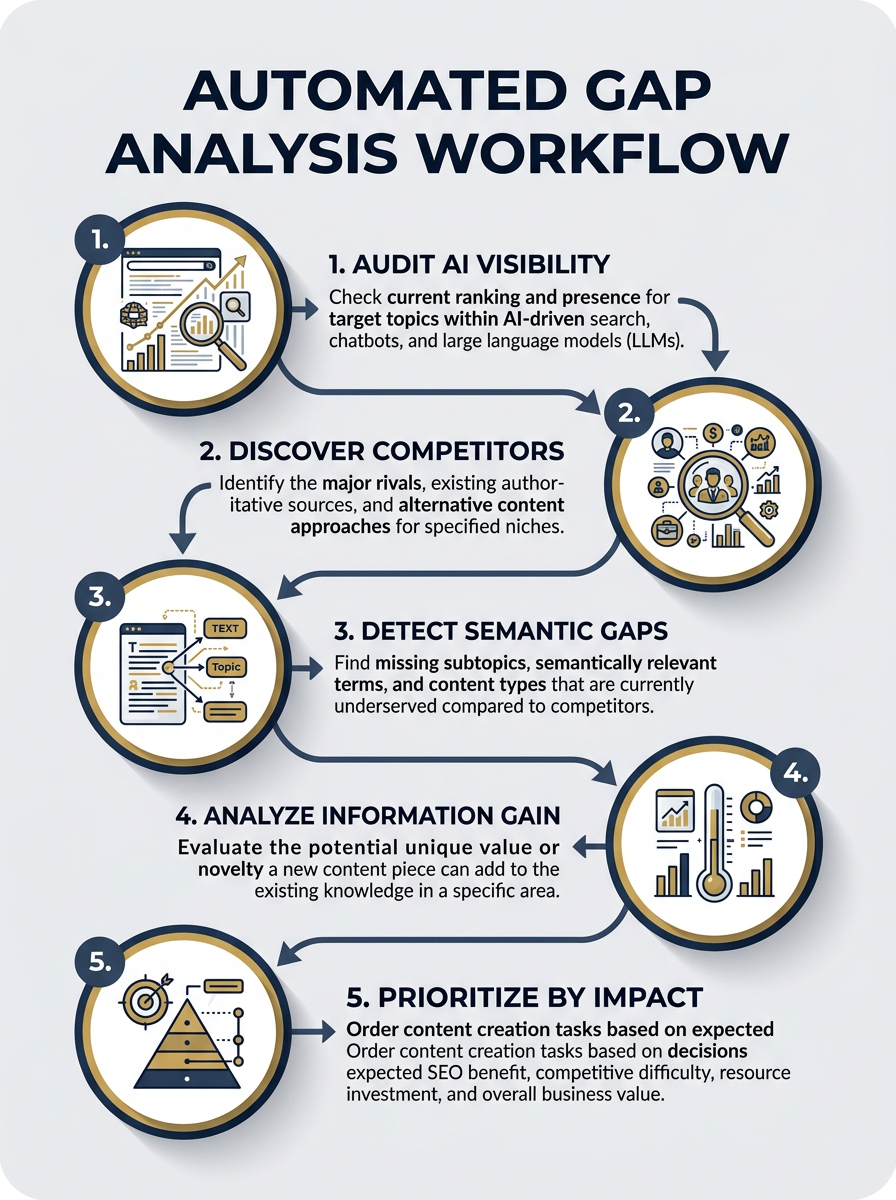
A Step-by-Step Framework for Automated Content Gap Analysis
To effectively fill gaps in 2026, brands should follow a structured, audience-led workflow that prioritizes high-growth areas [16]. This framework is essential for automating content gap analysis for competitive niches using AI research tools.
Step 1 and 2: Audit and Discovery
Before looking at keywords, establish a baseline of where you stand in the “answer engine” landscape. Use tools like Otterly.ai or manual prompt audits in ChatGPT and Perplexity to see if your brand is mentioned or cited for your core topics [5]. Next, use tools like Ranklytics or Semrush’s Organic Competitors report to find your real SERP competitors. In 2026, your business competitors are often different from your search competitors, who might be niche publishers or community sites like Reddit [2].
Step 3 and 4: Detection and Information Gain
Run a comparison to find “Missing” and “Untapped” keywords. Modern AI tools will automatically cluster these keywords into “Semantic Clusters,” grouping them by meaning and user intent rather than just word similarity [10]. For every high-priority gap, use an AI research agent to ask: What unique value does the competitor provide? Look for first-party data, expert quotes, or first-hand experience that your content currently lacks [21]. In 2026, content that rehashes the consensus will not rank in AI responses [5].
Step 5 and 6: Prioritization and Multi-Modal Gaps
Not all gaps are worth filling. Use an AI-driven “Opportunity Scoring” system to rank gaps based on commercial intent and AI Overview prevalence [19]. The new frontier for 2026 is multi-modal AI. Emerging research tools can now analyze visual and video content gaps. If your competitors are using high-quality video or interactive tables and you are not, this represents a significant engagement gap that AI models will notice [6].
Key Takeaway: A six-step workflow from auditing AI visibility to identifying multi-modal gaps ensures a comprehensive strategy for content dominance.
Frequently Asked: How do I prioritize content gaps?
Prioritize gaps based on commercial intent, AI Overview prevalence, and ease of implementation, focusing on updates to existing pages first [19].
Case Study: Using ChatGPT to Find Untapped Content Opportunities
Practical application of these tools demonstrates their value. A recent workflow involved using ChatGPT to analyze top 10 competitors in a niche to identify 5 untapped content opportunities [15].
Scraping and Clustering Competitor Content
The process began by scraping top-ranking pages from a competitive niche using AI tools. NLP was then used to cluster topics and identify common themes across the competitor set [18]. This step ensures that the analysis is based on actual SERP data rather than assumptions.
Identifying Missing Subtopics with ChatGPT
The team prompted ChatGPT to analyze clusters and suggest missing subtopics, validating suggestions with search volume and intent data [18]. This method revealed specific angles that competitors had overlooked, such as detailed implementation guides or specific use-case scenarios.
Results and ROI
Five new content pieces targeting identified gaps drove 30% more organic traffic, demonstrating a repeatable workflow for any competitive niche [15]. This case study highlights that automating content gap analysis for competitive niches using AI research tools yields tangible traffic growth when executed with precision.
Key Takeaway: A structured workflow using ChatGPT to analyze competitor clusters can uncover untapped opportunities that drive significant organic traffic growth.
Filling the Gaps: Strategic Content Operations
Once gaps are identified, the focus shifts to “Autonomous Content Operations.” This involves using AI writing tools that are embedded into your workflow, not just used for output [7].
Creating the “Golden Answer”
To close gaps in AI visibility, content should follow the “Golden Answer” format: direct, concise answers placed immediately after H2 headings to make it easier for LLMs to extract and cite [10]. Using structured formatting like bulleted lists and tables further improves “citability” [21]. This is crucial for brands using platforms like Autoriax, which provides reports in 6 languages with one-click PDF export, ensuring that the structured content is accessible globally [Product Truth].
Content Clusters and Internal Linking
Filling a gap is rarely about a single page. It involves building “Topical Maps” and internal linking architectures that signal expertise to search engines [10]. For example, Ranklytics automatically suggests internal linking opportunities to connect new content to existing high-authority pages [2]. Autoriax allows managing up to 10 brands per account with separate histories, facilitating this kind of scaled topical mapping for agencies [Product Truth].
Key Takeaway: Strategic operations involve formatting content for AI extraction and scaling internal linking across brand portfolios.
Future Trends: Multi-Modal and Autonomous Gap Analysis
The AI writing tool market has bifurcated into two tiers: platform gorillas like ChatGPT and specialized workflow tools like Jasper and Copy.ai [7]. For B2B brands and agencies, the strategic implication is clear: differentiation persists through workflow depth, not raw generation [7].
Multi-Modal Gap Analysis
By late 2026, content strategy is moving from reactive to predictive. Experts predict that AI tools will soon be able to forecast future content trends before they peak, allowing brands to fill “future gaps” and establish authority before the competition even identifies the niche [12]. Multi-modal AI will analyze video, image, and audio content gaps, making visual and interactive content critical for engagement [6].
Fully Autonomous Content Operations
In 2026, “Data Moats” are more important than ever. Established players have years of user interaction data and “brand voice” training that newcomers cannot easily replicate [7]. However, the 52% of enterprises building custom AI content tools suggests that niche, industry-specific automation is the new competitive battleground [7]. Autonomous agents will continuously monitor and fill gaps without human input, shifting the human role to strategy and oversight [9].
Key Takeaway: Future trends point toward predictive, multi-modal analysis and fully autonomous content operations that minimize human intervention.
Frequently Asked: Will AI replace content strategists?
AI will handle execution and monitoring, but human strategists are needed for oversight, brand voice consistency, and high-level decision-making [7].
Conclusion: Embracing Automation for Competitive Advantage
In the high-stakes environment of 2026, content gap analysis is no longer a periodic chore—it is an ongoing, automated intelligence function. By utilizing AI research tools to identify semantic, intent, and citation gaps, brands can move beyond simple keyword rankings to become the authoritative source cited by the world’s most powerful AI models.
To maintain a competitive edge on domains like autoriax.com, the roadmap is clear: audit your AI visibility monthly, automate competitor tracking with real-time tools, prioritize based on “Information Gain” and commercial intent, and scale through agentic SEO and autonomous content operations [9]. As search evolves into a conversation between users and AI, the brands that identify what is missing from that conversation will be the ones that own the results [17]. Filling these gaps isn’t just about traffic—it’s about establishing long-term authority in a world where being the “answer” is the only way to remain visible.
Sources
[1] Real-Time SERP Monitoring: The New Standard for Content Gap Analysis - https://moz.com/blog/real-time-serp-monitoring-content-gaps [2] Gap Analysis - Ranklytics - https://ranklytics.ai/features/content-gap-analysis [3] The Death of the Manual Content Audit: Why Automation is Non-Negotiable - https://www.forbes.com/sites/forbestechcouncil/2026/03/10/the-death-of-the-manual-content-audit/ [4] Beyond Keywords: Using LLMs for Semantic Competitive Mapping - https://ahrefs.com/blog/semantic-competitive-mapping-llms/ [5] 12 Best Content Gap Analysis Tools for AI Search in 2026 - https://slatehq.com/blog/best-content-gap-analysis-tools [6] The New Frontier: Multi-Modal AI for Visual and Video Content Gap Analysis - https://techcrunch.com/2025/11/14/the-new-frontier-of-multi-modal-seo-research/ [7] Competitive Landscape: AI Writing Tools (2026) - Luminix AI - https://www.useluminix.com/reports/competitive-intelligence/competitive-landscape-ai-writing-tools-2026 [8] Automating Competitive Intelligence: How AI Research Tools Are Changing the Game - https://www.semrush.com/blog/automated-competitive-intelligence-future/ [9] The Rise of Agentic SEO: Automating Content Strategy in Competitive Niches - https://www.searchengineland.com/agentic-seo-content-gap-automation-2026 [10] AI-Powered Keyword Research: Complete Guide 2026 - https://www.digitalapplied.com/blog/ai-keyword-research-complete-guide-2026 [11] The 2026 State of Marketing: AI Research and Content ROI - https://www.hubspot.com/state-of-marketing-2026-report [12] The Shift to Autonomous Content Operations: Expert Predictions for 2026 - https://www.marketingaiinstitute.com/blog/autonomous-content-operations-2026 [14] How AI Research Agents are Redefining Content Strategy - https://www.technologyreview.com/2026/01/15/ai-research-agents-content-strategy/ [15] Case Study: Scaling Content in High-Competition SaaS Using Autoriax-style Automation - https://digitalmarketinginstitute.com/blog/case-study-scaling-content-automation-2026 [16] How an AI Gap Analysis Can Save Your Content Strategy - https://www.linkedin.com/pulse/how-ai-gap-analysis-can-save-your-content-strategy-rellify-hvcbc [17] What is content gap analysis? How AI is transforming the way brands identify content opportunities | Click Consult - https://www.click.co.uk/insights/what-is-content-gap-analysis-how-ai-is-transforming-the-way-brands-identify-content-opportunities [18] How I Run a Competitive Gap Analysis Using This AI Tool (In Under 5 Minutes) - https://www.youtube.com/watch?v=2usm4k2uUc8 [19] Content Gap Analysis: How to Find and Fill the Topics You’re Missing - https://www.gwcontent.com/blogs/news/content-gap-analysis [21] Content Gap Analysis: A Step-by-Step Guide - https://www.semrush.com/blog/content-gap-analysis
Try Autoriax free — no credit card required
Get your first article in minutes. See the research depth before you commit.
Get 3 free articles3 articles free • No credit card • Cancel anytime